Showing posts with label Revision. Show all posts

Monday, April 17, 2017

Submit. Then Revise and submit again.

1 comments
by Susan J Berger

I think writing is easier than submitting. It's hard to send your story out knowing that there is a very good possibility you will be rejected.
Today I read a post on Literary Rambles on R&R (revise and resubmit) from the POV of agent Natalie Lokosil of The Bradford Agency and debut author Lindsey Becker. 

Lindsey writes of her journey to acceptance with her debut book. The Star Thief. Literary Rambles is always worth reading and is a great guide to agents. If you are not using it as a resource, you're missing a good bet.  I put the link to the post above.
Just in case you want to check out The Bradford Agency, here's a link to their guidelines. http://www.bradfordlit.com/submission-guidelines/
and Here's  a link to Natalie's page
http://www.bradfordlit.com/about/natalie-fischer-lakosil/
I've submitted to Sarah and Laura at The Bradford Agency. (Neither of them do picture books.) I think I would like to try Natalie.
 
Last week I got out two picture book queries - the snail mail kind.
Clarion Book, a division of Houghton Mifflin is now accepting unsolicited submission for children's books and separately for artwork.

Children’s Books:

Manuscript Submission Guidelines

Clarion Books and Houghton Mifflin Harcourt Books for Young Readers are the hardcover imprints of the Houghton Mifflin Harcourt Books for Young Readers Division.
Please note: Presently, only Clarion Books is accepting unsolicited submissions. HMH Books for Young Readers will not be reviewing unsolicited submissions at this time.
While we accept unsolicited and unagented submissions, we do not respond unless we are interested in publishing the work or would like to request a revision. Our time frame for a response is up to twelve weeks. We regret that we cannot respond personally to every submission, but each manuscript does receive careful consideration.
Your manuscript should be typed and submitted via mail. We do not accept submissions by e-mail or fax. Please do not send a self-addressed return envelope or postcard, as materials will not be returned. Manuscripts will be recycled if we determine that they are not a match for our publishing program.
For picture books and novels, please send the entire manuscript. For nonfiction, submit a synopsis and sample chapters.
When submitting work to any publishing house, it is useful to check your local bookstore or library to get a sense of the company’s publishing style. This research may also help you determine which HMH imprint is best for your work. Please submit exclusively to one HMH imprint.
Submissions to Clarion Books should be sent to the following address:
Clarion Books / Submissions
3 Park Avenue, 19th Floor
New York, NY 10016

Illustration Submission Guidelines

The design department receives samples from potential illustrators of picture books and fiction book jackets for Clarion Books and Houghton Mifflin Harcourt Books for Young Readers. (Illustrations that are part of a picture book dummy with text should be submitted to the editorial department per the instructions above.)
Send color copies or tear sheets; do not send original artwork or slides. Please show a limited selection of your strongest work. Illustrations that feature children or animals are helpful, but feel free to submit other subject matter. Samples will not be returned. We will contact you only if we have a potential illustration assignment.
Our mailing addresses are as follows:
Clarion Books OR Houghton Mifflin Harcourt Books for Young Readers
Design Department / Art Samples

3 Park Avenue South, 19th Floor
New York, NY 10016
Houghton Mifflin Harcourt Books for Young Readers
Design Department / Art Samples

125 High Street
Boston, MA 02110
I vow to do at least one submission next week. On a happier note, I have two books eligible for the Crystal Kite Awards. Two. How's that for wonderfulness?

Earthquake, 2nd Edition is a non fiction book about Earthquakes with factoids and some fun experiments. and Mom, is There a Santa Claus? is a picture book about - well the title says it all.

 If I had don't this post last week, I could have asked for votes.
Timing is everything.
SUBMIT!
 

Monday, November 2, 2015

That Revision. Again.

14 comments
By Susan J Berger
I'm not doing NaNoWriMo this year. My priority this November is Revision.
Again.
I am in awe of Karol Silverstein whose first draft of Cursed was impeccable. Kate's Hero is in fifth draft. I used NaNo last year to do a revision during which I lost the first forty pages of a previous revision and re-wrote extensively to make up for that loss..
I sent it out to a beta reader feeling o-so-proud and found I had a lot more revising to do.
Plus I have another ms in second draft.

My Revision Steps

Step one:
Spell check and punctuation check. I am a terrible typist.

Step two: Kill the unnecessary words:
The Craft of Writing  Fiction says there are five words you can always cut:
I checked these words first.
just,  70 (just has always been one of my personal favorites to over-use.)
really – 19
Quite -7
Perhaps 13
That  392 (Noooo!)

Rebecca Laffar Smith at the Craft of Writing Fiction has a caveat re the word that: This word needs careful consideration. It’s not always one that can be cut without thought like the four above. In that sentence, and this one, the word “that” is used to define the subject of the sentence. But sometimes, even when used in this way, it is not necessary.

“DIE, REPEAT WORDS! DIE!”  Ask any author I have edited and they’ll most likely roll their eyes and tell you how I chased after them with a knife, threatening to stab every ‘that’ I saw unless they did it first. Okay, guilty. ::grins:: I’m pretty much murder on repeat words and phrases. Nothing flattens an author’s creative voice worse than those repeats. They need to be the first to go. Make a list, run a global search on each, and get rid of them. Biggest and most frequent offender: the dreaded ‘that.’ About 90% of the time the word isn’t necessary. Chop it out.

Other repeats to look for: so, was, little, bit, then, take, came, went, looked, stepped, moved, saw, watched, felt/feeling, rather, somewhat, large, but, small, up, down, over, under, just, though, however, because, very, really, truly.

Especially with directional words up, down, over, under, you can clear out most. Think of it in terms of how the body moves. When you sit or sink onto an object, you can only sit/sink ‘down’ unless for some reason you want to specifically sit ‘up,’ (obviously you can’t ‘sink up’) in which case you are better served using ‘straightened in her chair’ instead of ‘sat up’ in her chair. In a bed it can go either way, your choice, sit or sit up. But if your character sits on a chair, they only need to sit. Same with stand. You can only stand ‘up.’ So your character only needs to ‘stand.’

Are you confused yet? Now you know how editors sometimes feel. But hey, look: easily 50% of repeat words already gone because you cleared out ‘that’ and its cohorts, plus ‘unneeded directional words!’ Excessive coolness.

I followed Char’s list: What I found:
was – 557  (AAAARGH!!!!)
up - 215
looked  171
but 163 (oi!),
down -125
then 75
so 107
take  106
felt/feeling – 96
over – 89
small - 48
very -43
little - 48 (cut it to 14)
bit - 47 (cut to 17)
came – 41
This is my book and I want it to be the best book I am capable of writing and that includes nit picking the use of every over-used word listed above on a case by case basis.
I am not as worried about the rest of her list. 
went - 29,  stepped - 17, moved - 17, saw - 17, watched 14, rather -14, large - 14, under 22, though – 9 because – 31 truly - 1  however – 1 somewhat -0 (Yes!)
Step three.
Read your book out loud. Yup. Sit at your computer or print out a copy. It's amazing what I discover when I perform this step. (You will have to print another copy after you read your story out loud and the odd blooper or shaky writing shows up. Which I why I prefer to do the read-aloud at the computer.)

Step four
Print out a fresh hard copy. Put it in a binder. Make a title page. Write a great blurb (or put the name of an author you love and pretend you are reading their book.)

Read like a reader. Take minimal notes. Fight the urge to edit

5 Symbols you can use:

  1. Smiley face: Like it a lot
  2. Check mark: Story Dragging
  3. ( ): Clunk writing. Metaphors they don't work. Sentences that don't make sense.
  4. O : Material missing.... Transition point? Explanation?
  5. ? : What was I thinking? I am Confused!

Now I make notes for myself.
What, if anything did I find missing?
Did I stay in POV? (I am currently on a POV edit on my fifth draft.)
At what point could a busy editor put my book aside and not come back to it?
What do I need to change to make it compelling?

Now you are ready for the next draft. Rewrite according to the new story. (Please let this be the definitive draft.)
Write On!


Monday, October 12, 2015

Need a Nudge? Try NaNoWriMo

1 comments
Have you started a book which you’ve never had time to finish? You are not alone. I had ideas galore. But getting them down and finishing that first draft? Let me say it took me a year and an half, a commitment to my critique group and a lot of personal nagging to finish a first draft of a middle grade book.  Then I discovered NaNoWriMo.

National Write a Novel Month takes place in November. It began in 1999, when Chris Baty and a group of friends got together and challenged each other to write a novel of 50,000 words of more in ONE MONTH. Why? Who knows? Crazy!

But seven people completed the challenge. They did it again the next year with more people… This will be the sixteenth year of the marathon. It has become an international event with more than 100,000 [R1] participants. 
This blurb from their website: 
National Novel Writing Month (NaNoWriMo) is a fun, seat-of-your-pants approach to creative writing. On November 1, participants begin working towards the goal of writing a 50,000-word novel by 11:59 PM on November 30.Valuing enthusiasm, determination, and a deadline, NaNoWriMo is for anyone who has ever thought fleetingly about writing a novel.
In 2014:
  • 325,142 participants, including 81,311 students and educators in the Young Writers Program, started the month as auto mechanics, out-of-work actors, and middle school English teachers. They walked away novelists.
  • 849 libraries, bookstores, and community centers opened their doors to novelists through the Come Write In program.
  • 55,774 Campers tackled a writing project—novel or not—at Camp NaNoWriMo.
Sound interesting to you? My first thought was 50,000 words in one month? No way!!! The longest piece I’d ever written was that mid grade novel – about 16,000 words. But what if I could? I explored the NaNoWriMo website and decided to give it a shot.
It was an amazing experience. What I had given myself was a huge gift – a deadline.
In November 2004, I sat down at the PC without an idea in my head, just a determination to do a daily stint of 2000 words. (I belong to the Pantser school of writers. The plot emerges from my subconscious as I write.)
The first sentence was “I am beginning. I don’t know how I got here and the world is full of strangers..” Horrible sentence, but I kept on writing.
Often my inner critic would look at what I wrote and say, “This is awful!” But my looming deadline gave me the courage to silence my inner snarker with these words. “Never mind, it is word count. Keep writing.”

Another joy of NaNo? Getting a pep talk from a well known author in your mail box every week in November. Here are a few SCBWI members gave: Kate DiCamillo, John Green, Tamora Pierce, Walter Dean Myers Here’s is a link to all the previous SCBWI author pep talks.

I kept writing. I attended local NaNo write-ins. I powered through sticky awkward sentences to scenes I was proud of, and on November 30, 2004, I had a 50,000 word first draft of a first person YA novel called Missing. Frabjous joy!!
(Slight problem: After I read it through, I realized I had used Robert Heinlein’s Mars stories as a model and that science is no longer valid. Someday I will figure out how to overcome that and revise the novel.)
Next!
In 2006 I gave NaNo another shot and didn’t finish. I hated what I’d written. No one yelled at me except my inner critic.
Next!

In 2009 I tried again. This time I came up with a first draft I knew I could revise into a better story.
Many drafts later, Soul Mate Publishing offered me a contract for Second Chances, which was reborn as Time and Forever and published in 2014.


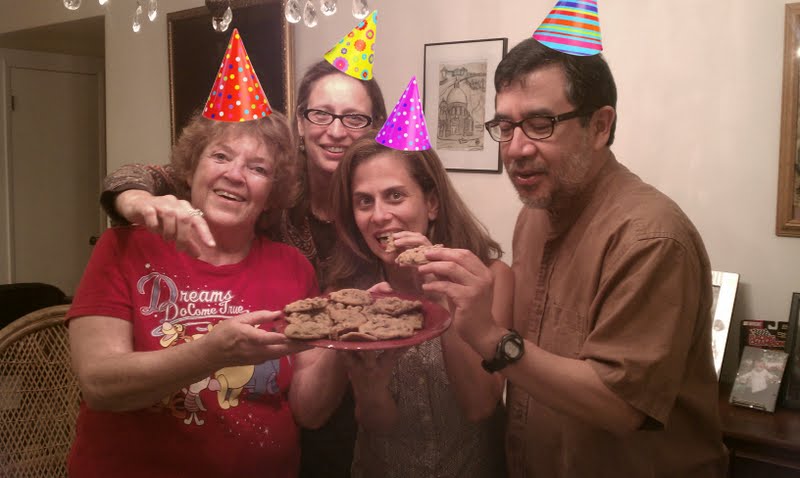
Hilde’s making cookies for me to attract people to my table. The cookies alone are worth your visit.


I’ve written two more novels during NaNo, I am on revision number 7.5 of Kate’s Hero which I wrote during the 2013 NaNoWriMo. The third is still waiting my attention.

Biggest pieces of advice:
Be like Dory in the movie Finding Nemo. “Just keep writing, just keep writing. Do. Not. Edit. As author Sarah MacLean says, “That’s for future you to worry about.”
Name your inner critic (I call mine Ethel), and tell her/him to take a vacation till the end of November. If you keep your fingers moving and write through the junk, a beautiful something will emerge.
Go ahead! Give yourself an adventure. http://www.nanowrimo.org/
You have no idea what is possible till you try it.
Have fun! And if you're around, stop by Buena Vista Branch of the Burbank Public Library on Saturday between 1:00 PM and 4:00 PM

Monday, November 10, 2014

It's Nano Time. Quotes to keep you writing

5 comments
By Susan J. Berger


It's NaNoWriMo time again.   I am following Dawn Knobbe's lead  and using this years' NaNo to make last years novel into a readable 2nd/3rd draft.
She also did a post on inspirational quotes for NaNoWriMo.
If you've never tried National Novel Month, it's a great way to get a first draft. Deadline is everything . You have thirty days to do it.


This isn't about being perfect. It's about getting the words out. If you get the words out, the story will come. I guarantee there will be lots of surprises.

"Here's the bottom line; writers write. Sometimes words flow easily. Sometimes it's like sloughing through mud. Either way a professional writer keeps writing."
P.C.Cast
 
 "A word after a word after a word is power." - Margaret Atwood

Dory and I have so much in common. I often stop to Google.


“Don't worry about what you're writing or whether it's good or even whether it makes sense.” 
Lauren Oliver
“Remember: Plot is no more than footprints left in the snow after your characters have run by on their way to incredible destinations.”
Ray Bradbury.
 
Advice from a Hollywood NaNoWriMo coordinator.
"When all else fails, throw in a Zombie."
Will you revise after NaNoWriMo? Of course, but right now the trick is meeting the deadline.
 
"There's an old folk saying that goes: whenever you delete a sentence from your NaNoWriMo novel, a NaNoWriMo angel loses its wings and plummets, screaming, to the ground. Where it will likely require medical attention.”
Chris Baty
 
“You can't edit a blank page”
 
Happy writing.


Sunday, September 7, 2014

To Die or Not To Die...

5 comments
When a Character Must Simply Go.
by Hilde Garcia

I have been working on my young adult novel for a few years now and just when I thought I was at the finish line, something tugged at me, but it was hard to pin point exactly what it was.

I began a major revision, knowing that I would be happy with the outcome even before I started.  As I played it out in my mind, it was really sharp and strong, except for this one small problem.

A character that simply would not die. 


In fact, I teach 5th and 6th grade and during our Language Arts class, I showed my students older drafts of my novel. They all marveled at how long I had been writing some of my stories and some noticed that it was longer than they had been alive.

We also noticed an old synopsis that stated that my main character’s father died in an earlier draft.  Hmmm…  so I had been down this road before and how I got lost and ended up back at this point, I have no idea, but it helped solidify my resolve.

I pulled the trigger.

In a very teary scene, my character’s father dies while on a dangerous journey on the ocean with his daughter, leaving her to survive by herself. That’s quite an obstacle for her, but as I wrote the chapter where she finds out he is dead, it wrote itself.  It flowed and it felt right. The chapter read the way I had originally envisioned it, but somehow convinced myself that HE, the dad character, had to be in the story.

I was taking an intensive writer’s workshop with MaggieStiefvater during the SCBWI Summer Conference and she struck a chord.  “If you don’t find a character interesting, don’t write about them.”  And I had been forcing myself to like the father, write about the father, give him a backstory, but in the end, he didn’t need to be there, it wasn’t his story.

Also, Linda Sue Park, during that same day, pointed out that sometimes you have to see what is necessary.  In an exercise, she had us delete an entire chapter- well a section of a chapter- and then try to recreate it from memory. 

“If it was really important, you will be able to recreate it,” she said to us.  When I tried it, I couldn’t recreate it. It made me wonder just how much of my novel didn’t need to be there for me to tell my story.  In fact, one editor on a panel during the Conference said, “If it’s over 100,000 words, I am not going to read it.”  This made me think a bit.  Could I say it with less words, less scenes, less characters?  Maybe I had characters duplicated and they could be morphed into one. 

Of course, we had all saved our precious chapter elsewhere, as a security net, just in case, but the exercise was beneficial.  Sometimes we are redundant in our writing, duplicating characters, adding details and “stuff” that doesn’t need to be there.

These authors enlightened my way of looking at my novel.

Editors look for a tight manuscript and many of the techniques these authors shared at the intensives were extremely vital when you get to that level of polish before you send your work out into the universe.

SO I killed him. The dad. He is gone, caput, rode out into the sunset.

Now what?

Well, time to revise every chapter that followed and erase his existence.


The pen is the mighty sword after all.